 EN
 PT
 RU
 ZH
 ES
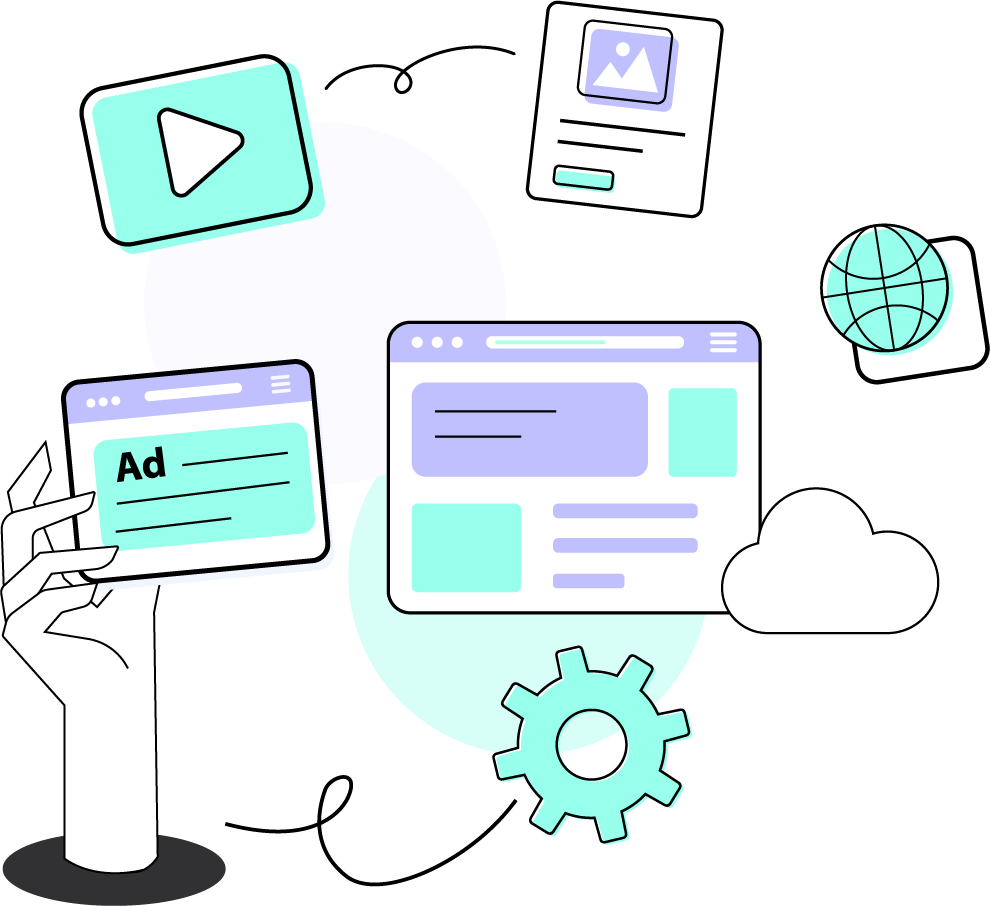
To succeed in affiliate marketing, you need to use the right marketing mix to guide customers into buying your products. Remember that affiliate marketing is a performance-based type of marketing where the affiliate company is not interested in your efforts but only wants to see results. Therefore, to ensure that prospects are clicking on the provided link and you are getting your commission, you need to embrace the use of affiliate ads.
This article takes a detailed look at the types of affiliate ads in affiliate marketing, which are as follows:
Different Types of Ad Formats in Affiliate Marketing:
Affiliate marketing supports different types of ad formats to attract its target audiences, generate clicks and leads, and drive sales and conversions. Each of the ad formats functions in its own way to capture user attraction and promulgate affiliate offers. Understanding each ad format individually will help you identify the most suitable options for your business growth and align your advertising efforts with your campaign objectives through Customer journey tracking. On this note, here are the top affiliate marketing-related ad formats for your consideration:
1. Pop Ads:
Ads that pop up when visitors are browsing the internet. Pop ads are pretty straightforward. They are not as intrusive and challenging as other ads. You can reach your target audience and even track their campaign by using pop ads to deliver effective results. There are different types of pop ads, and they include:
i) Pop-over Ads:
Advertisements that get displayed over the existing content of a webpage as a typical overlay. They get triggered when a user visits a website, clicks a specific element, or executes some other predefined action. They are displayed as a promotional message in the foreground of a webpage. Examples of pop-over ads include an affiliate website promoting a software product that might display a pop-over ad to highlight a limited-time discount or a free trial through an e-commerce referral program.
ii) Pop-under Ads:
These ads are opened in a new browser window, generally behind the user's main active browser window, and work in the background until the user switches windows or finishes interacting with the current page. For example, an affiliate might use a pop-under ad to promote an online service, where users need to be directed to a dedicated landing page containing details of the offer and a registration option.
2. Banner Ads:
These are the most popular ad formats in digital and affiliate marketing, displayed on websites, blogs, ecommerce sites, mobile games, and other social media channels. When users click banner ads, they are redirected to a landing page, an affiliate offer, or onto a product page. Their structure typically consists of an image, headline, supporting text, call-to-action (CTA), and destination link. Examples of banner ads include showcasing the top 10 holiday destinations on a travel blog or promoting electronic products on a tech blog through an affiliate product platform.
3. Interstitial Ads:
These ads appear when users switch between screens or game levels or after completing an activity on a website or application. Interstitial ads consist of static visuals, videos, animations, or interactive elements. As an example, a mobile game app may display an interstitial ad promoting another game when users reach certain levels, with App install attribution helping marketers measure campaign effectiveness.
4. Push Ads:
For push ads to be effective, you'll have to set up a landing page. Push ads are also content-oriented. Before your visitor clicks the link to your landing page, you need to convince them with words. Your landing page needs to have high-quality content that converts prospects. There are two types of push ads: the push and the in-page push. Push ads are the regular notifications that web browsers or mobile apps generate. In-page push ads are in the form of banner ads, and a web page generates them. Note that push ads require more time to create. You have to get the content and design right if you hope to see immediate results.
5. Native Ads:
Native ads don't look like an ad at first glance, but when you pause and look at it, you'll find out they are. Native ad campaigns are technical to set up. You need to have key details like your audience demographics and their interests. Creating native ads takes more time than creating push ads. A perfectly created native ad will lead to a high ROI. Finally, other types of affiliate marketing ads to use are search (Google) ads and social ads. Google ads serve marketers who have a special offer targeted to a specific set of people. Social ads present marketers with lots of targeting options. However, both come with strict rules, and not obeying them could get your account banned.
How To Select The Right Ad Format For Your Affiliate Campaign?
When the market is swamped with a plethora of advertising formats, selecting the right one for your business requires a clear understanding of the target audience, campaign goals, available budget, and overall conversion journey. The best ad format is the one that targets the right audience at the right moment with the right message, contributes to meaningful conversions, offers a value proposition with the selected offers, and provides a positive user experience throughout their purchasing journey.
Let us have a brief look at the factors governing the selection of the right ad formats for your affiliate campaigns:
1. Setting Out Campaign Objectives:
The ad formats should support different types of campaigns with different objectives, such as measuring brand awareness, driving web traffic or generating leads, increasing existing sales figures, promoting app installs, boosting audience engagement, and improving conversions. If, say, your objective is increasing brand awareness, then in that case, using banner ads, native ads, video ads, and other social media placements can help introduce the brand to the right audiences. If your goal is lead generation, then leveraging native ads, search ads, email marketing, social media ads, and textual ads will be more suitable to spur users to fill out a form, opt for a free trial, complete an online website registration, or request more information.
2. Targeting the Right Audiences:
Marketers should target different audiences with different types of ad formats based on where their potential audiences spend their time online, what content they are interested in consuming more, how they respond to programmatic advertising, and which devices they use more.
For example, a tech geek who reads more product reviews may be more receptive to reading native articles, comparison content, search ads, or demo videos. Similarly, push notifications are more appropriate for users who have opted in to receive timely product updates. The format should align with users' browsing habits rather than coercing them into any inconvenient experience.
3. Evaluate the Budgetary Requirements:
Marketers should account for costs connected with their campaign, including costs incurred for landing page development, fulfilling affiliate software tracking and optimization needs, funds needed to perform A/B testing, and more. Some ad formats require more time and cost than others. For example, banner ads are less costly and quicker to create, while any native ad requires more time and cost to produce product comparisons, sponsored ads, product recommendations, product listings, and others. However, the most suitable ad format is not the one that is less expensive; rather, it is the ad format that can attract the attention of valuable users, generate profitable returns, and produce necessary conversions within the allocated budget. For a successful campaign, marketers may need to test different kinds of audiences, select necessary ad placements, messages, landing pages, and real-time bidding strategies within the allocated budgets. The cost of traffic should result in the necessary value of the conversions it produces.
4. Determining the User Experience:
If the ad format disrupts the browsing experience and creates an irksome experience with many technical glitches or obscures essential information, users may leave dissatisfied during their journey and not engage further with the offer. While banner ads are less disruptive, as they occupy less space within a webpage, if misplaced, they can interfere with user navigation or make it simple for users to ignore them. Pop-over ads are quite captivating, but if they are excessively overlaid, then they may prove distressing for users. This can erode users' trust levels and result in increased abandonment rates. Responsive ads that are well-positioned, load quickly, and have clear CTAs can help provide a satisfying user experience across devices, whether mobiles or desktops, supported by a Mobile analytics platform wherever applicable.
An ad must always be in conformity with user expectations. For example, an interstitial ad that is promoting a mobile app should direct users to a relevant app page. Similarly, if a banner is promoting a discount or offer, then its landing page should clearly display that offer in lucid terms. Any mismatch or discrepancy observed between an ad and its landing page can undermine user trust and adversely affect the number of conversions a brand can generate.
Hence, marketers must always track conversion rates, user engagement levels, and bounce rates and control ad frequency levels to provide a positive user experience. The best ad formats are the ones that balance UI/UX with user convenience. By prioritizing accessibility, ease of navigation, transparency, and relevance, affiliate marketers enhance user experience and improve both conversion quality and user engagement.
Benefits of Different Types of Ad Formats:
Selecting the right type of ad format can help affiliate marketers catch users' attention, explain the offer in clear terms, and increase the conversion rate without creating a poor user experience. Let us see the benefits of each of the ad formats in detail below:
Banner Ads:
Banner ads are less disruptive and do not interrupt the user's browsing experience while they promote the brand's products or services. They are easy to place and come in varying sizes. These ads remain clearly visible while users browse websites and help build brand awareness, even when users do not click them instantly. They support brand recognition on account of their repeated exposure, thereby helping users remember them for a long period of time. However, if these ads lack appeal and relevance, then users ignore them without taking any suitable action, simply because they look too commonplace. Banner ads are commonly used to promote products that correspond to the contents of the webpage. For example, a fitness blog could display a banner ad promoting workout equipment or healthy supplements through a Fitness products affiliate campaign.
Pop-over Ads:
Pop-over ads appear when a user has already read a section of an article and is about to navigate to the next section or is almost leaving the webpage. When timed properly, these ads help marketers display an offer at the correct moment when the user is more likely to respond. They contain a great deal of information, even more than a banner, and should have a clear close option. If users are unable to close them, then that leaves them nagging and deserting the website altogether.
Pop-under Ads:
Pop-under ads open in a new browser window behind the current webpage and do not unnecessarily cover the entire content; hence, they offer a seamless and frictionless browsing experience for the users. Marketers use pop-under ads to provide additional information about the offer without impeding the user's present activity.
Interstitial Ads:
When it comes to making event announcements, promoting app downloads, and limited-time offers, then interstitial ads are beneficial. They occupy a large chunk of the user's screen and appear within webpages or in-between the breaks of the user's current activity. Their main benefit is to increase brand visibility. They pop up quite instantly even before the user completes reading out the current webpage and navigates to the next page, keeping the user's focus intact in transitioning between different pages. Since they are quite noticeable in gaining users' attention, they should not be conflicted with the user's current activity, especially when the user is in the midst of executing an important task such as downloading an app or filling out a form.
Conclusion:
There is no one-size-fits-all approach when it comes to applying different ad formats to your marketing campaigns. The right choice depends on factors such as the campaign objective, the nature of the target audience, budgetary requirements, and more. For affiliate marketers to succeed in their marketing game, they should A/B test multiple ad formats and fine-tune different creative elements and landing pages at specific intervals. The end objective of using this ad format is not to attract the customers' attention but to convert relevant attention into meaningful outcomes. Hence, marketers must leverage relevant ad formats in the most effective way to refine audience targeting, enhance user engagement, and achieve their campaign objectives.